
Google signs $920M-per-month compute deal with SpaceX to meet AI demand
 admin
admin 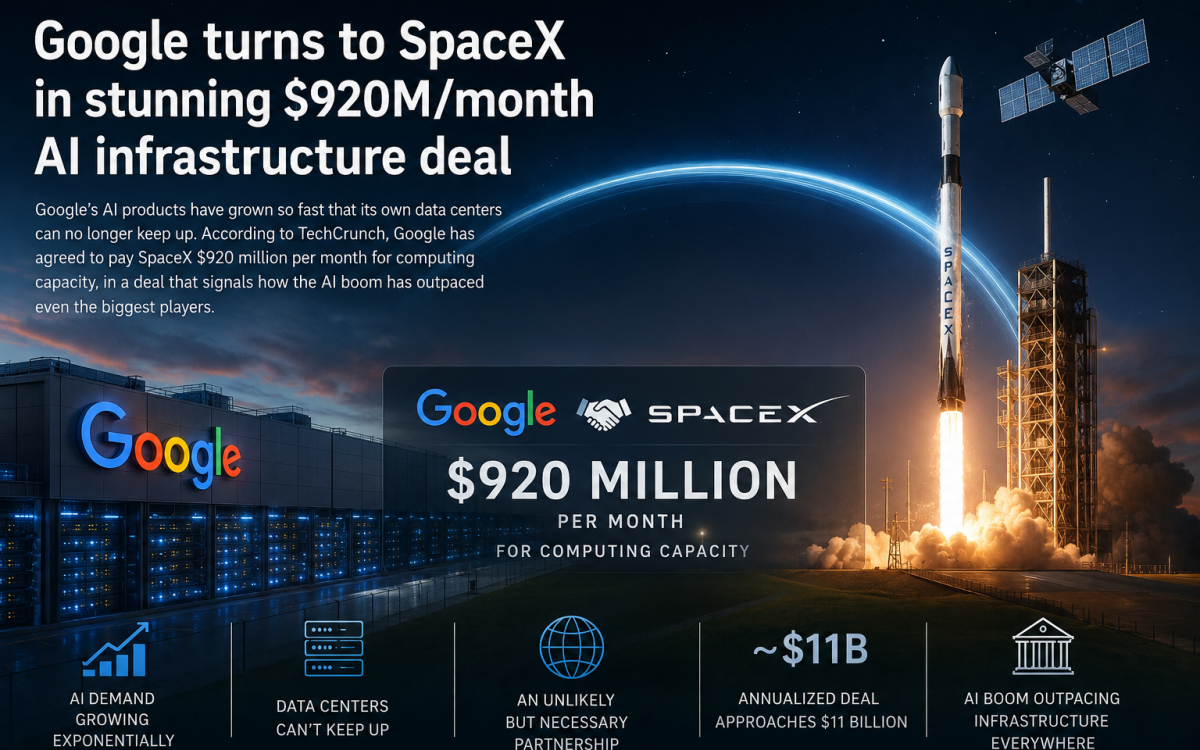
Google’s AI products have grown so fast that the company’s own data centers — among the most extensive on the planet — can no longer keep up. According to a report by TechCrunch published in June 2026, Google has agreed to pay SpaceX $920 million per month for computing capacity, turning to Elon Musk’s rocket and satellite company as an unlikely but apparently necessary partner in its AI infrastructure push.
The figure is staggering even by the standards of an industry that routinely throws around ten-figure numbers. Annualized, the deal approaches $11 billion — roughly equivalent to the entire R&D budget of a mid-sized European nation’s tech sector. It signals something important: the AI boom has outpaced the ability of even the best-capitalized companies to build their way out of a capacity crunch.
How Google ended up here
Google has invested heavily for years in its own AI-specific silicon — the Tensor Processing Unit line — and operates a sprawling global network of data centers. That infrastructure has served it well through multiple waves of product launches. But the rapid uptake of Gemini, the AI-heavy redesigns of Search, and the expanding suite of AI features across Workspace appear to have created a demand spike that couldn’t be absorbed by existing capacity on the timelines Google needed.
The company’s options were limited. Building new data centers takes years and billions in capital expenditure. Renting additional capacity from traditional hyperscalers like AWS or Microsoft Azure is possible, but brings its own complications — including the awkwardness of funding a direct competitor’s infrastructure business. SpaceX, which has built out substantial computing resources for its own Starlink constellation operations and internal programs, represented a different kind of option entirely.
What the deal actually covers
The full technical specifications of the arrangement haven’t been disclosed publicly. It’s not yet clear what hardware is involved, where the physical infrastructure is located, or how the workloads are being split between Google’s own facilities and SpaceX’s resources. What TechCrunch’s reporting establishes is that Google is treating this as a capacity bridge — a way to handle near-term and medium-term demand while its own infrastructure investments catch up.
That framing matters. This isn’t Google outsourcing its AI business to SpaceX. It’s more analogous to a manufacturer renting factory floor space during a demand surge while its own new plant is still under construction. The strategic dependency, at least for now, appears to be temporary rather than structural.
What makes this unusual is SpaceX’s position in the market. Unlike Amazon, Microsoft, or Google itself, SpaceX does not operate a public cloud platform. It doesn’t sell compute capacity to the general market. A deal of this scale, with a non-traditional provider, suggests the conventional cloud market couldn’t meet Google’s needs — either in terms of available capacity, pricing, or both.
Implications for the broader AI industry
The Google-SpaceX arrangement is likely to accelerate a conversation the industry has been having for some time: compute availability is becoming the single most constrained resource in AI development, and the companies that control it hold enormous leverage over everyone else.
For smaller AI startups and enterprises building on top of Google’s infrastructure, this dynamic is worth watching carefully. If Google itself is capacity-constrained enough to cut unconventional nine-figure monthly deals, the trickle-down effect on pricing and availability for lower-tier customers could be real. Cloud compute costs have already been climbing across the board; nothing in this deal suggests that trend reverses anytime soon.
There’s also a geopolitical dimension that shouldn’t be overlooked. Both Google and SpaceX are American companies, and a deal of this scale — processing data at this volume, potentially including data from European and other international users — will draw scrutiny from regulators who are already skeptical of how much of the world’s critical digital infrastructure is concentrated in a handful of US-based firms. The EU’s AI Act and ongoing data sovereignty debates give European regulators meaningful tools to ask pointed questions about where this data is going and under which legal framework it’s processed.
A deal that reflects the state of AI in 2026
Strip away the headline number and what you’re left with is a surprisingly candid admission from one of tech’s most powerful companies: we launched products faster than we could build the infrastructure to run them.
That’s not a criticism — it’s a structural reality of how competitive the AI market has become. The pressure to ship, to keep up with OpenAI, Anthropic, and a wave of well-funded challengers, has pushed every major lab to prioritize product velocity over infrastructure planning. The bill for that choice, apparently, is nearly a billion dollars a month — and it’s being handed to a company better known for landing rockets than running server racks.
Whether this becomes a model other AI companies follow — tapping non-traditional compute providers when hyperscalers can’t deliver — may be the more consequential story here. SpaceX just demonstrated that it can operate at the very top tier of enterprise infrastructure deals. That changes what it is, not just what it does.
AI-assisted article, editorially reviewed — news4tech.eu